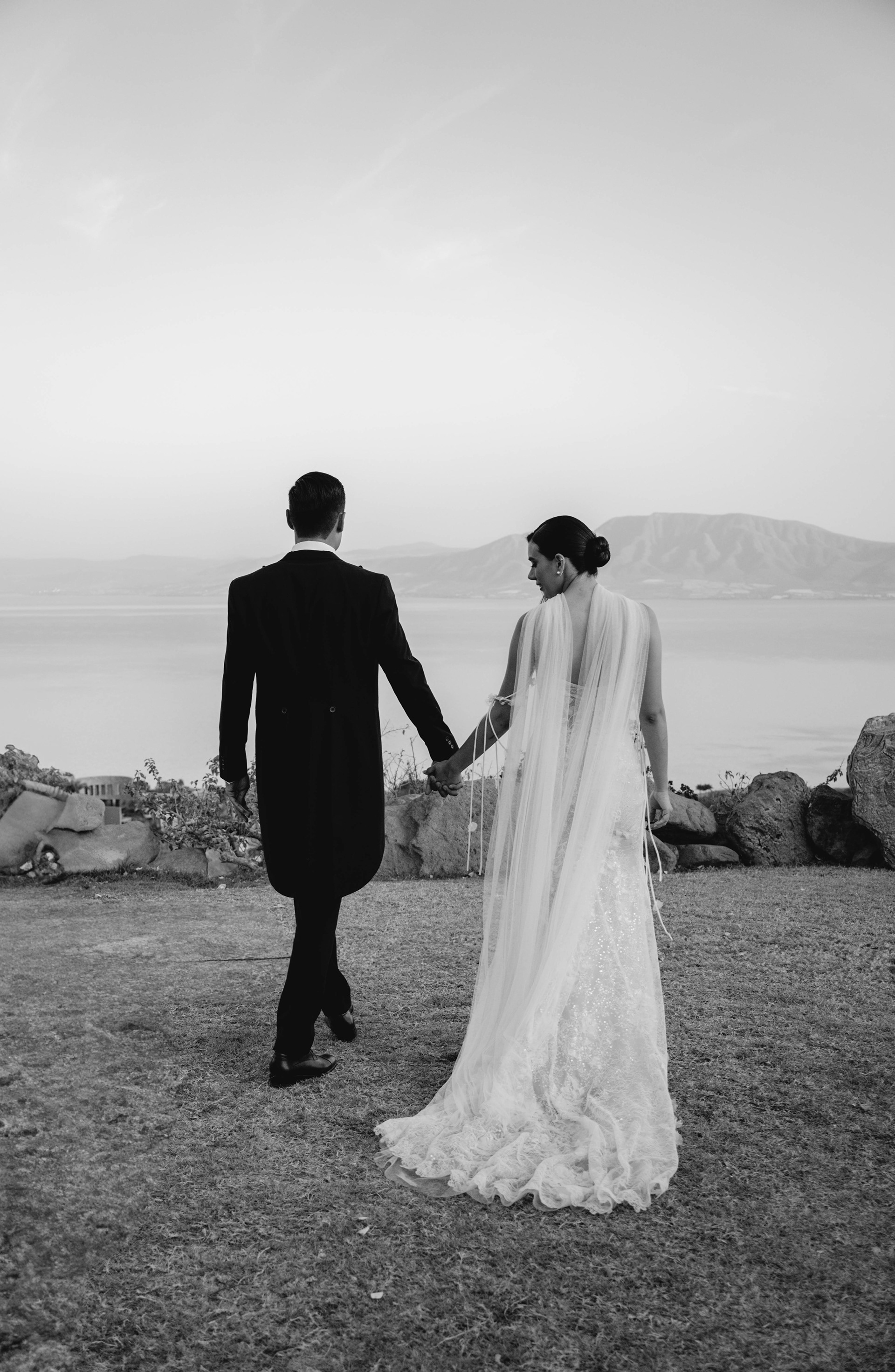
Sarah didn't speak much Spanish when she first messaged me. She was marrying Rodrigo, whose entire family is from Guadalajara, and she was terrified — not of the wedding, but of feeling like a guest at her own celebration. What happened instead is what this story is about.
Where it started
Sarah is from Austin, Texas. She met Rodrigo in Houston, where he had moved for work four years earlier. When they got engaged, the question of where to get married had a clear answer for both of them: Jalisco. Rodrigo's family — parents, grandparents, aunts, cousins — were all there. His grandmother was in her eighties and hadn't left Mexico in fifteen years.
"We knew immediately it had to be Mexico," Sarah told me during our first call. "Rodrigo's abuela can't fly. And honestly, I wanted to meet his world — not just his family at a wedding in Houston."
That sentence told me everything I needed to know about what this couple cared about. They weren't coming to Mexico for the backdrop. They were coming because Mexico was the only honest choice.
The planning: 11 months, two countries
Sarah and Rodrigo booked the venue first — a hacienda in the Jalisco highlands, about an hour from Guadalajara's airport. They found it through a recommendation from one of Rodrigo's cousins. It had stone archways, hand-painted Talavera tiles, and a central courtyard that turned gold at about 5:15pm in November.
They came to me nine months before the wedding. That gave us time to do something I always push for with American couples: a proper planning timeline that accounts for the specific light at their specific venue at their specific time of year.
We built the day backward from golden hour. Ceremony at 4pm. First look at 3:30. Family portraits at 5pm during the tail end of that golden light. Reception at 6:30. Getting ready coverage starting at 10am.
The other thing we spent time on: the family portrait list. With 68 guests split between Sarah's family from Texas and Rodrigo's family from Guadalajara — some of whom spoke no English, some of whom spoke no Spanish — the portrait session needed to run without any confusion about who was standing where.
I asked for the family list in advance. I organized it into Spanish-speaking groupings and English-speaking groupings, and I had a plan for sequencing them so I could move between languages without stopping. The portrait session took 38 minutes. They'd budgeted an hour.
The day
Sarah's getting-ready room was a converted hacienda suite with north-facing windows — diffused, even light all morning. Her bridesmaids, three from Austin and one from Dallas, were louder than any group I've photographed in Jalisco. The noise level was so dramatically different from typical Mexican getting-ready rooms that the hacienda staff kept walking by the door just to see what was happening.
At 11am, Rodrigo's mother knocked on the door and asked if she could come in. She didn't speak English. Sarah didn't speak Spanish. They stood across from each other for a moment, and then his mother held out a small jewelry box — a pair of earrings that had belonged to Rodrigo's grandmother. No words necessary. Sarah put them on and they both started crying.
I was in the room. I got the frame.
That moment — the earrings, the look between them — became the couple's favorite image from the entire wedding. Not the ceremony. Not the portraits. Not the first dance. The moment two women who shared a language barrier gave up on translation and understood each other completely.
The ceremony and what came after
The ceremony was bilingual, with the officiant alternating between English and Spanish. Rodrigo's grandmother sat in the front row in a chair that the venue staff had carried specifically for her — the regular pew seating was too low. She wore a burgundy dress and held a white handkerchief for the entire ceremony. She didn't use it until Rodrigo read his vows in Spanish.
Golden hour arrived exactly when we'd planned for it. The light came through a cypress grove on the west side of the hacienda and turned the stone archways into something out of a painting. I had Sarah and Rodrigo there for exactly 22 minutes before the light shifted.
"I was terrified I would feel like an outsider at my own wedding. What actually happened is that I've never felt more welcomed in my life. And the photos — when we got them the next morning, I cried all over again." — Sarah, Austin, Texas
The gallery delivery
Sarah and Rodrigo received their first 30 images the following morning — before they left the hacienda for their honeymoon. Sarah's message when she opened them: "I'm sitting on the terrace crying. My in-laws are asking what happened. I showed them the earring photo. We all cried again."
The full gallery — 612 images — was delivered in the time frame we had agreed to in writing. No surprises. No "the editing is taking longer than expected." The date was in the contract, and the delivery was on the date.
What I didn't expect: six months after the wedding, Rodrigo's grandmother passed away. Sarah told me that the photos from the wedding — especially the ones I'd taken of her with the couple during the reception — are now the family's primary visual record of her at a celebration. "They're what his family is looking at right now," she said. "They're more important than I realized they would be."
What this wedding taught me about destination photography
Every destination wedding I photograph has a version of what happened in that getting-ready room — a moment where the cultural boundary dissolves and something completely human takes over. My job is to be ready for it before it happens, and positioned to capture it without interrupting it.
That requires knowing the day's sequence well enough that I'm never scrambling. It requires being present without being intrusive — which in a small hacienda suite with eight people is a specific skill. And it requires the kind of trust that only comes from couples who actually know who they hired and why.
Sarah and Rodrigo found me 9 months before the wedding. They knew what they were getting. And on the day, they could forget I was there — because they already trusted where I'd be.
That's the kind of wedding I want to photograph. If it sounds like yours, let's talk.