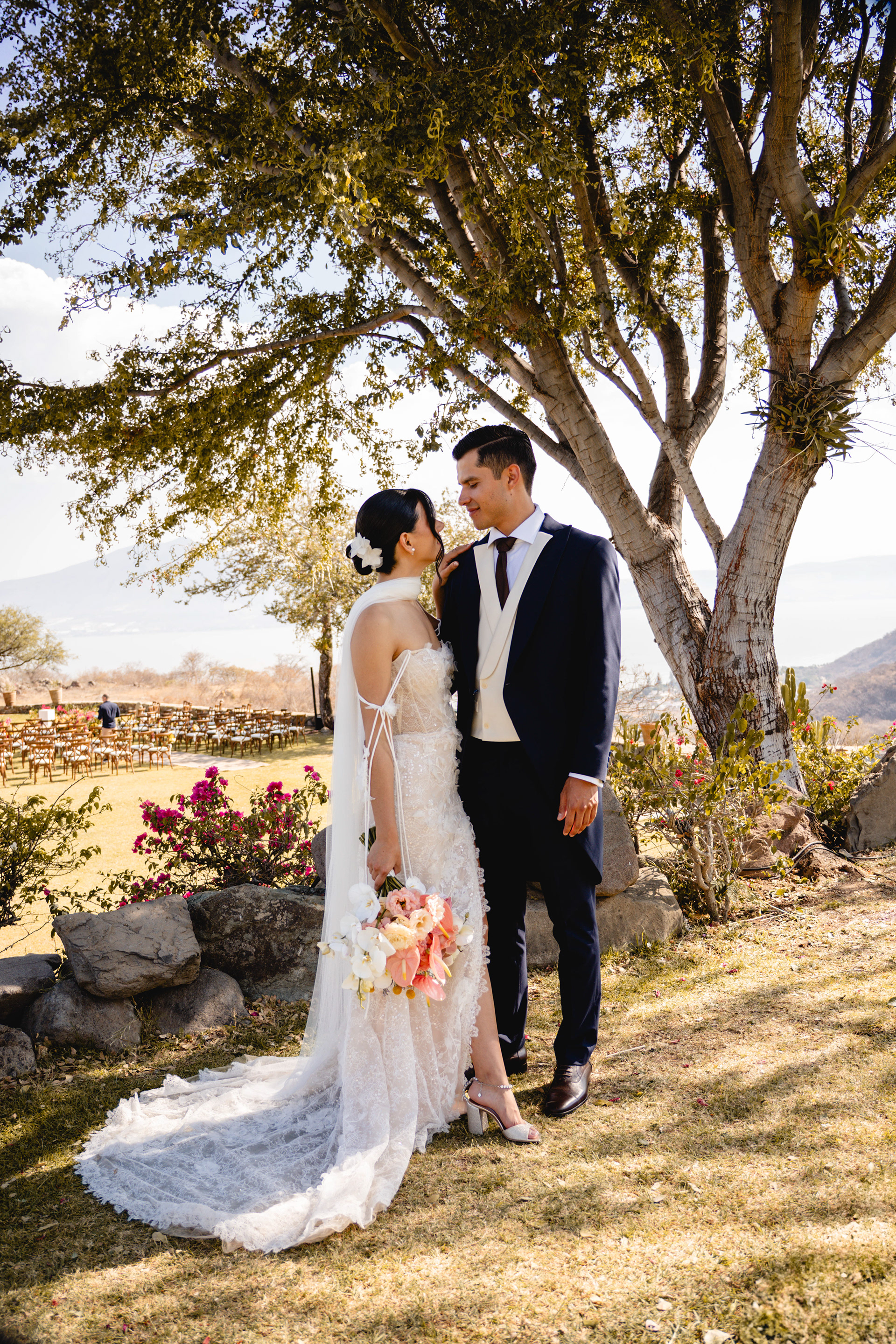
Your wedding is in Mexico. The venue staff speaks Spanish. The coordinators speak Spanish. The priest or officiant speaks Spanish. Your groom's family speaks Spanish. Your photographer speaks English only. At 4pm, when the light is perfect and you're rushing between the ceremony and portraits, something important gets lost in translation. You just don't know it yet.
How language affects vendor coordination on the day
On a wedding day in Mexico, the photographer is the person who moves most freely throughout the event. They're present at getting ready, the ceremony, cocktail hour, portraits, and reception. This means they interact with more vendors than almost anyone else — the venue coordinator, the catering staff, the florist who arrives late and needs to be redirected, the DJ who needs to know when to hold the first dance music.
When that photographer speaks only English, every one of those interactions becomes a friction point. They have to find someone to translate. The message gets distorted. Time gets lost. In a wedding day where the light lasts 45 minutes and the sunset portraits window closes permanently, those lost minutes matter.
At one wedding I photographed, I noticed the florist had placed the arch slightly off-center from where the ceremony light would fall. I walked over, explained the issue in Spanish, and they adjusted it in 90 seconds. An English-only photographer would have had to find the planner, explain the problem, wait for translation, and the moment might have passed. The arch stayed wrong.
A bilingual photographer doesn't just communicate with your vendors — they do it with the speed and confidence that gets results. Mexican hospitality culture responds to warmth and directness in Spanish. When someone walks up and says "permíteme explicarte algo" in their own language, the response is immediate and positive. That's not magic, it's just communication working the way it's supposed to.
Directing family portraits in two languages
Family portrait sessions are the most logistically demanding part of any wedding day. You're moving groups of 4 to 20 people, many of whom don't know each other, into specific positions, in a limited time window, before the light changes.
If you have American family and Mexican family — which is almost always the case at destination weddings in Mexico — your photographer is directing both groups simultaneously. The grandparents on your groom's side may not speak a word of English. The college friends who flew in from Dallas may not speak Spanish.
A bilingual photographer switches between languages without stopping. The grandmother understands instantly. The college friends understand instantly. Nobody stands there waiting to figure out what they're being asked to do. The portrait session takes 35 minutes instead of 55 minutes, and the light doesn't die while you're still doing family groupings.
This sounds small until you're standing in front of your partner's entire extended family, the sun is setting, and you're watching a 20-minute light window evaporate because nobody can coordinate.
The emotional cost of miscommunication
Beyond the logistics, a language gap costs couples something they cannot get back: a Mexican grandmother's toast that the American side never understands, an in-joke that lands for half the room. The practical coordination issues are real, but the emotional layer is what couples actually regret afterwards.
Destination weddings in Mexico often involve one partner who doesn't speak Spanish marrying into a Mexican family. The American bride arrives to a venue full of people speaking a language she doesn't understand. She can't follow the conversations. She can't connect with her future mother-in-law the way she'd like to. She feels, in a low-grade constant way, slightly isolated at her own wedding.
A bilingual photographer is one of the few vendors who can bridge that. Not by translating every conversation — that's the planner's job — but by being someone she can communicate with fully, who also moves easily through the Spanish-speaking parts of the day, who can whisper to her "your mother-in-law just said she's never seen her son so happy" in a quiet moment that doesn't get translated in real time.
That kind of connection changes how relaxed the bride is. And relaxed people photograph better. It's not abstract — you can see it in the photos.
What it looks like in photos: Stress shows in shoulders, jaw, and eyes. Couples who feel supported and understood throughout the day have relaxed body language. Couples who feel vaguely anxious — who can't follow what's happening around them — hold tension that shows up in every frame. A bilingual photographer reduces one major source of that anxiety.
Cultural translation — beyond the words
Language and culture are not the same thing, but they're deeply linked. A photographer who grew up in Mexico and speaks Spanish natively doesn't just speak the language — they understand the rhythms of a Mexican wedding celebration.
They know that the lasso ceremony has a specific visual sequence worth capturing. They know which family members are likely to cry and position themselves to get that shot. They know that the tossing of the bouquet in Mexico is different from the US tradition. They know the uncle who's going to do something memorable during the baile and they're already watching him.
They understand, from cultural knowledge, the difference between a formal Mexican family's body language and an informal one — and they adapt their direction style accordingly. They know not to rush a Mexican abuela into a portrait pose, but to invite her slowly and let her settle. The resulting photo is completely different from the one you get when she's being directed impatiently in English.
Bilingual communication in the planning phase
The value of bilingual communication starts before the wedding day. During the planning phase — often 12 months of emails, calls, and coordination — your photographer may need to communicate with your Mexican venue, your planner, or vendors you haven't found yet.
A bilingual photographer can help you understand what the venue coordinator is really saying about logistics. They can review a Spanish-language vendor contract and flag anything unusual. They can hop on a quick call with your planner in Guadalajara and clarify a detail about the ceremony timing that's been going back and forth in email for two weeks.
This kind of support is not something most photographers include in their service — they show up on the day, photograph it, and leave. But when you're marrying in another country, having a photographer who is also a bilingual ally in the months before the wedding is a genuinely different experience.
It changes the relationship from vendor to collaborator. And collaborators make better weddings.